On December 13, 2012 I had a trial in Newport District Court for expired vehicle registration. Specifically, I was charged with violating RSA 261:40. For those who aren’t familiar, Newport is a much smaller town than Keene. Normally in Keene, as well as Manchester, Concord and I would guess most other District Courts throughout New Hampshire, there are many people scheduled for trial at the same date and time. This was not the case in Newport. Aside from myself and seven others from Keene, the only people in the court were Trooper Hickox (who was prosecuting his own case), one bailiff, a court clerk and the judge.
Before the trial began, the judge issued an edict that only one camera would be allowed to operate during the trial, despite the fact that three individuals filed notices to record. He immediately took a brief recess so that the camera situation could be straightened out and stated that if a decision wasn’t reached on which camera was to be the camera to record the trial, that NO cameras would be allowed. (more…)
Seven Keene activists accompanied Darryl W. Perry to Newport District Court for an 8:30 AM trial on the charge of failure to register his vehicle, RSA 261:40. Darryl was issued a summons on May 16, 2012 after being pulled over on South Main Street in Newport, NH by State Trooper Jason W. Hickox.
Hickox acted as prosecutor and sole witness for the “State of NH.” He testified that his reason for running Darryl’s plates was that they were Texas plates that looked “unusual.” He claimed that when he asked Darryl for license and registration, Darryl provided a ‘driver’s license’ as well as proof of ‘registration’ from Texas, which he alleges was expired. Hickox stated that Darryl was not violating the speed limit, driving unsafely, or driving in any manner hazardous to other drivers.
Hickox testified that Darryl agreed to abide by the man-made legislation supposedly valid in this particular region of land simply by driving within the boundaries commonly known as New Hampshire.
Darryl mentioned article 3 of the NH Constitution and referred to the surrender of certain natural rights in return for protection. He noted that police officers are not duty-bound to protect and without protection, the surrender of rights is void.
Darryl also cited article 10, the right of revolution, and stated that he never agreed to nor signed anything to fall under the arbitrary jurisdiction. He claimed to be part of the Shire Society and cited the fourth precept, stating,
FOURTH, explicit voluntary association is the only means by which binding obligations may be created, and claims based on association or relationships to which any party did not consent are empty and invalid;
Jason W. Hickox was unable to provide any physical evidence proving Darryl was guilty beyond a reasonable doubt of the claims against him.
After the prosecutor finished testifying as the only witness, Judge Cardello denied Darryl’s motions to dismiss and to receive exemption. The judge deemed Darryl “guilty” of the alleged “crime” of failing to pay ‘the state’ for permission to own and operate his own property and said Darryl must pay a $100 fine and a penalty assessment fee of 24%, or $24.
Darryl’s request to donate $124 to charity in lieu of the fine was denied, but request for community service was granted; Darryl will complete 12.5 hours of community service.
Yesterday the case of State v Garret Ean was heard in regards to a $29.76 bicycle headlamp citation. While trial footage recorded by Free Keene videographers uploads, it’s worth making a note of the events before the trial, which resulted in one individual being temporarily banned from the courthouse for filming in the lobby. When I arrived just after 8:30am, I saw James of Shire TV standing outside of the front door and filming in. It was clear what had just occurred — he had been kicked out for filming. I’ve been in the same situation at Concord district court, where you will likely get ejected for recording outside of the courtroom. Sometimes, I am allowed through security with one camera but not another, and sometimes nothing is restricted.
On the inside, my videocamera was taken and replaced with a scruffy old property receipt, a number sharpie’d on it. I saw a slew of activists from Keene in the lobby speaking with bailiffs. Word was spreading that all cameras were being taken, even those with filled-out permission slips, until the judge authorized the forms. Myself planning to audio record the entire hearing, I had yet to fill out the blank media form which has three options: Still Camera, Video/Audio Camera, or Audio Recording. As my audio recorder and cell phone were not confiscated, I waited to fill out the copy in the courtroom.
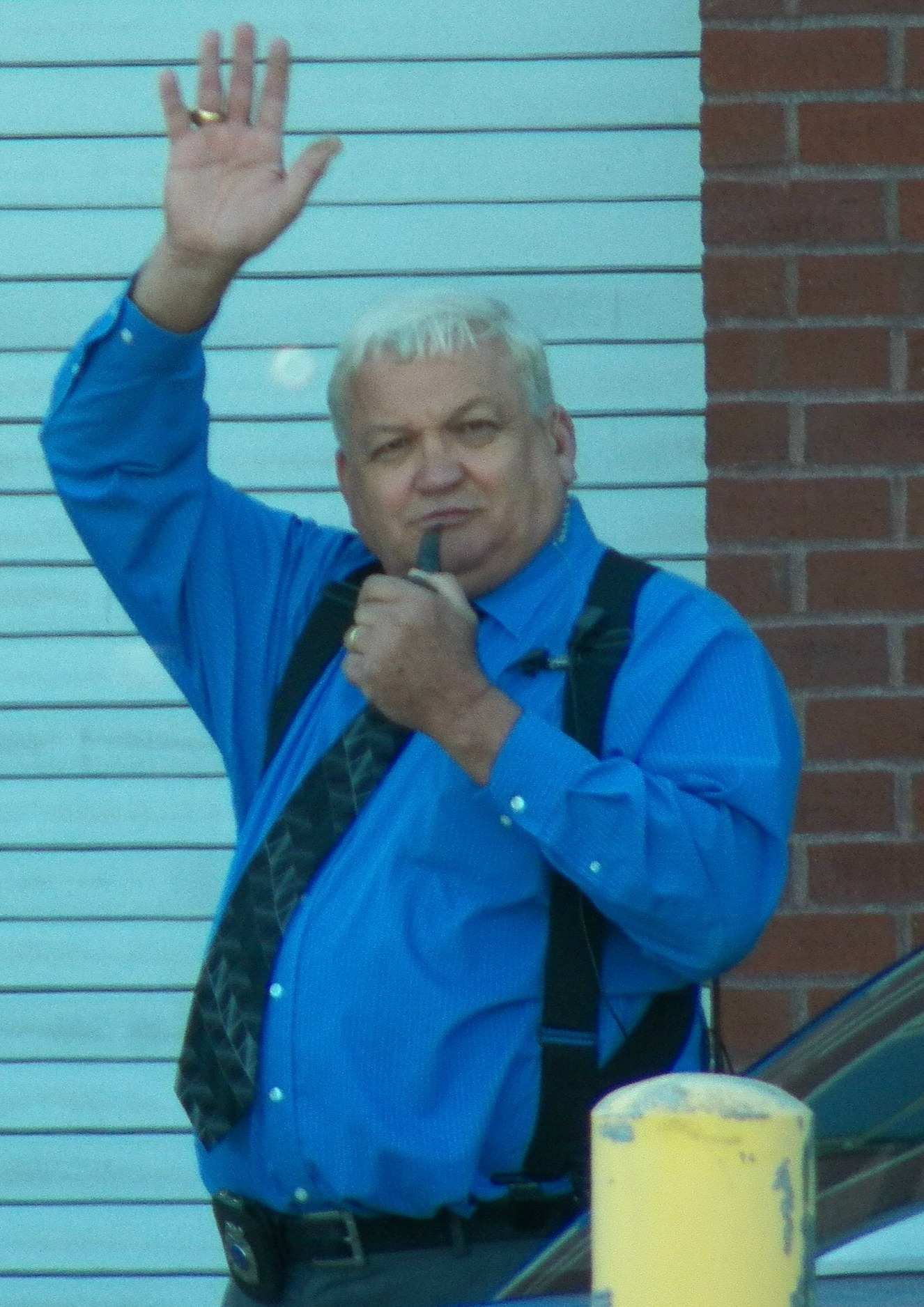
Concord District Court head of security Peter Hamilton enjoying a pipe on break. Photo by Brian Blackden
I asked bailiffs why that today they had decided to seize all incoming videocameras. “The judge always authorizes recording, so why does everyone need to have their property confiscated?” The head of security, Peter Hamilton, appeared and stated that the judge who always grants approval of notices was out this particular day. He was possibly referring to judge Gerard Boyle, whom to my knowledge has not denied any press notifications placed before him. I have audio and video recorded others’ trials before both he and the sitting judge on this day, M. Kristin Spath, without hassle from either. This does not also include a lack of hassle from the bailiffs. My experience has been that having a filled out recording permission slip to present at the checkpoint does make one more likely to emerge on the other side with their camera unswiped. Hamilton cited rules handed down by Edwin Kelly as the basis for the restriction, Kelly being the very secretive administrative judge of New Hampshire district courts. (more…)
As you may be aware, I was arrested for video recording in Palmer, MA’s town hall back in October. At the time, I was given a report from the arresting officer, Raymond Tenczar, indicating he believed I was guilty of “disorderly conduct” for allegedly loudly causing a “disturbance” outside of the room in which the city was going to hold a tax sale. If you watch the video of the arrest, you’ll see that I do raise my voice, but only at the time Tenczar places his hand on me to arrest me.
Apparently, the Palmer police and/or prosecutor realized that they had no case for disorderly conduct, and the misdemeanor charge was dropped. More detail on the charge droppage later in this article.
However, they completely changed the circumstances of the charge and the evidence in their case for the remaining town ordinance “disorderly conduct” violation. Now they are alleging that I was “disorderly” in front of the open house, which happened prior to the tax sale. In an unsigned report, allegedly written by Palmer police officer Sean M Ford, he claims I was yelling at the town attorney and attempting to intimidate him. (more…)
Bright and early tomorrow morning in Concord district court, there will be a trial concerning Garret Ean’s year-plus old contempt of cop bicycle citation. Folks will be traveling from around the Shire to attend, and you’ll get to see Free Concord’s editor grill on the witness stand the CPD sergeant whose juvenile and brutish response to an audio recording inspired the blog’s very first article. More time has passed since the matter being heard tomorrow than passed between the first and second incidents with the badged individual in question. Expect to see the video here of the policeman’s response to tough questions about how and why he executes his job. If you need a laugh in the meantime, check out this Concord Monitor article from October quoting a particular CPD officer as he praises the approval of a BEARCAT attack truck to be delivered by Homeland Security to the small city’s department.
On the federal front, congratulations to Colorado for earlier today becoming the second state to make available to the public legal cannabis. The herb has been greatly marginalized and ignored since its ban via taxation in 1938. Washington became the first state to nullify the federal ban when it implemented a ballot initiative four days ago that was approved by voters in November. While the Washington system maintains the prohibition on cannabis cultivation, Colorado’s statute allows for individuals to garden freely (within limitations).
Dec 16 2012: Full video of the trial published earlier today.